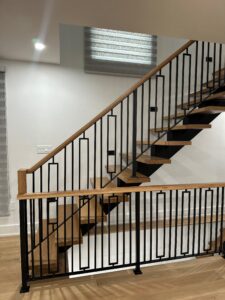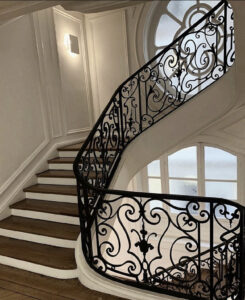
The height of a railing in a stairwell is measured straight up from the line of the stair nosings to the top of the rail, and for most homes it should land between 34 and 38 inches. Get that one measurement wrong and the rail can fail inspection, feel awkward in the hand, or leave someone without support at the exact moment they slip.
At PMF II Iron Works, we build and install custom iron railings across New York, and the most common question we hear from homeowners is simple: “Is my railing the right height?” The answer depends less on your tape measure and more on where you put it. This guide walks you through how to measure it correctly, step by step.
First, Know What You’re Measuring: Handrail or Guard?
People say “railing” for two different parts, and each one has its own height rule. Measure the wrong one against the wrong number, and you’ll get a false answer.
| Part | What it does | Where it’s measured from | Typical residential height |
|---|---|---|---|
| Handrail | The rail you grip while climbing | The nosing line of the stairs | 34 to 38 inches |
| Guard (guardrail) | The barrier that stops falls off an open side or landing | The walking surface (floor or landing) | At least 36 inches |
On many staircases, one rail does both jobs. When the top of a guard also serves as the handrail on the open side of the stairs, it must sit between 34 and 38 inches above the nosing line. On the landing, that same guard typically has to rise to at least 36 inches.
Tools You’ll Need
You don’t need anything fancy. A few basic tools will give you an accurate reading in about ten minutes.
- A steel tape measure (25 ft is plenty)
- A straight edge or a long level (4 ft works well)
- A torpedo level or a small square to keep your tape vertical
- A pencil and notepad, or your phone, to log each reading
- A helper, if the stairwell is tall or the rail is long
Step-by-Step: Measuring a Stair Handrail
The key idea is the nosing line: an imaginary sloped line that touches the front edge (the nosing) of every tread. Handrail height is always measured vertically from that line, never from the back of the tread or from the riser.
- Find the nosings. Locate the front edge of each tread. If your treads have a rounded lip that overhangs the riser, the tip of that lip is the nosing.
- Picture or mark the nosing line. Lay a straight edge across two or three nosings so it rests on their front edges. That straight edge is your nosing line.
- Hold the tape plumb. Place the end of the tape on the nosing line directly below the rail. Use a level to keep the tape perfectly vertical, not tilted to match the stair angle.
- Measure to the top of the rail. Read the tape where it meets the top surface of the handrail, not its underside or its bracket.
- Repeat along the run. Take readings at the bottom, middle, and top of the flight. Old houses settle, and a rail can be 36 inches at one end and 33 at the other.
- Write down every reading. Any single reading under 34 inches or over 38 inches is a problem worth fixing.
Quick check: if all your readings fall between 34 and 38 inches and stay within about an inch of each other, your handrail is in good shape.
Measuring Guards on Landings and Open Sides
Guards are measured from the floor, not the nosing line. If a landing, loft, or open stairwell edge sits more than 30 inches above the floor below, it generally needs a guard.
- Stand on the walking surface. Place the tape on the finished floor of the landing, right next to the guard.
- Measure straight up to the top of the guard. In a typical home, you’re looking for at least 36 inches.
- Check the openings too. Height isn’t the only safety test. Residential codes generally limit gaps between balusters so a 4-inch sphere can’t pass through. A quick test with a 4-inch ball or a piece of cardboard cut to size will tell you a lot.
- Note the transition. Where the sloped stair rail meets the level landing guard, measure both sides of the joint. This is where heights most often drift out of range.
Common Measuring Mistakes to Avoid
Most “wrong height” readings we see come from how the rail was measured, not how it was built.
- Measuring from the back of the tread. This adds several inches and makes a low rail look fine.
- Tilting the tape with the stairs. A tape laid along the slope reads longer than the true vertical height.
- Measuring to the bracket or underside. Always measure to the top of the gripping surface.
- Taking just one reading. A single spot can hide a sag or a settled post somewhere else on the run.
- Ignoring finished flooring. If you plan to add carpet, tile, or new treads, the nosing line will rise. Measure against the finished surface, or plan for the change.
- Using the handrail number for a guard. A 34-inch rail may be a perfect handrail but too short as a landing guard.
What New York Homeowners Should Know
New York follows the same basic 34-to-38-inch handrail range used in national model codes, but the exact rules depend on where your property is and what kind of building it is.
- Outside New York City: one- and two-family homes and townhouses fall under the Residential Code of New York State, which is based on the International Residential Code.
- Inside the five boroughs: the NYC Building Code applies. For one- and two-family homes and inside individual apartments, a guard that doubles as a stair handrail must be 34 to 38 inches above the nosing line.
- Commercial and multi-family common areas: stairwells in shops, offices, and apartment-building hallways often need taller guards, commonly 42 inches. Don’t assume the residential numbers apply.
- Older buildings: a railing that was legal when installed may not meet today’s code. Repairs or renovations can trigger an upgrade.
Codes are updated and enforced locally, so confirm the current requirements with your town’s building department or the NYC Department of Buildings before you build or replace a railing.
When to Call a Professional
Measuring is a great DIY task, but fixing a railing that’s out of range usually isn’t. Bring in a pro if you notice any of these:
- Readings below 34 inches or above 38 inches on the handrail
- A landing guard under 36 inches, or gaps wider than 4 inches
- Posts that wobble, or a rail that flexes when you lean on it
- A renovation, sale, or inspection coming up
- A curved, winding, or multi-level stairwell where measuring gets tricky
Final Thoughts
Measuring the height of a railing in a stairwell comes down to three habits: measure from the nosing line for handrails, from the floor for guards, and always hold the tape straight up. Take several readings, write them down, and compare them with your local code.
If your railing doesn’t measure up, PMF II Iron Works can help. We design, fabricate, and install custom iron stair railings and guards for homes and businesses throughout New York, built to look great and meet code. Visit pmfii.com to request a free estimate.