There’s a moment I never get tired of. A customer stands in front of a finished railing or a set of driveway gates, and they go quiet for a second. Then they say some version of the same thing: “That’s exactly what I pictured.”
That moment is the whole job, really. It’s also the clearest way I know to explain what bespoke metal fabrication actually means. Not a catalog number. Not a “close enough” size that you shim into place and hope nobody notices. Something built once, for one property, to one set of measurements.
I’ve spent a long time around this trade, and so has my family. We were established in 1960 — it started with my grandfather running a small iron repair shop out of a building attached to his house in Aveiro, Portugal. My father brought that work to the States, welding garbage trucks for a couple of years before opening his own shop in Jamaica, Queens in 1995. Today we’re in Freeport, New York, running a 6,000-square-foot fabrication facility with a showroom out front. Sixty-plus years, two countries, same craft.
So this post is my honest attempt to explain how custom metalwork actually works — what it costs you in time, what it gives you back, and how to tell whether your project needs it.
What “Bespoke” Really Means in a Metal Shop
The word gets thrown around a lot. In our shop, it has a specific meaning: the piece does not exist until you order it.
Stock railing comes in fixed lengths with fixed post spacing. It works fine when your stoop happens to match the factory’s assumptions. But most properties don’t. Old Long Island homes settle. Stair treads run at odd rises. Commercial landings get built to whatever the site allowed that week. A brownstone stoop from 1920 and a new-build deck in Freeport have almost nothing in common dimensionally.
Bespoke means we measure your actual conditions, design to those numbers, fabricate to those numbers, and install. No filler strips. No awkward gap at the wall where the last section ran short.
It also means the design is yours. We use computer-aided design software alongside our standard product line, which lets us show you exactly what you’re getting before a single piece of steel gets cut. You can start from something in our catalog and modify it, or start from a sketch on a napkin. Both happen regularly.
Residential Work: Where Custom Pays Off Most
Homeowners are often surprised that custom isn’t the extravagant option they assumed it was. Here’s where it tends to earn its keep.
Railings and Stairs
This is our bread and butter. Interior railings, exterior railings, handrails, full stairway systems. We can work with an existing structure or design a complete new run from scratch. Stainless steel if you want a clean contemporary look, wrought iron if you want something with weight and detail.
The functional argument is simple: a railing that fits properly is a railing that stays tight for decades. The aesthetic argument is that a handcrafted railing changes how a house reads from the street.
Gates and Fencing
Driveway gates and ornamental walk gates get designed one at a time, in conversation with the customer. Swinging, sliding, or folding — the right answer depends on your grade, your driveway length, and how much room you have to swing.
Fencing follows the same logic. A fence built to your specifications conforms to your architecture instead of fighting it, which is the difference between a fence that looks intentional and one that looks bolted on.
The Pieces People Forget
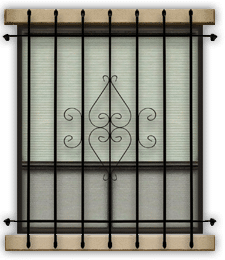
Window guards, window baskets, cellar well guards, exterior canopies, decorative posts, aluminum balconies. These are the details nobody photographs, but everybody notices when they’re wrong. Security hardware doesn’t have to look like security hardware.
Commercial Metal Fabrication: A Different Set of Problems
Commercial metal fabrication runs on different pressures than residential work. The aesthetics still matter, but three other things move to the front of the line: code compliance, durability under real traffic, and schedule.
We work regularly with contractors, architects, and designers, and the projects tend to fall into a few buckets:
Egress and access. Stairs, guardrails, handrails, and gates that have to satisfy inspection and survive hundreds of hands a day. Public-facing metalwork wears differently than a residential handrail used by four people.
Security and property protection. Gates, fencing, window guards, and cellar well covers for storefronts and multi-unit buildings. Same craft, higher demands.
Material handling and shop needs. This is the part people don’t expect from an ornamental iron shop. We fabricate custom tables, racks, and other equipment for factory and warehouse use. If you’ve got an odd corner of a facility and nothing off the shelf fits it, that’s a fabrication problem, and fabrication problems are what we do.
The advantage of working with a shop that handles both commercial and residential is that the standards cross-pollinate. Commercial jobs teach you to build things that survive abuse. Residential jobs keep you honest about finish quality. Your storefront railing gets built to commercial durability with residential attention to how it actually looks.
How a Custom Project Actually Goes
I want to demystify this, because “custom” makes people brace for a long ordeal. It isn’t one.
1. Consultation. We start with a free design consultation. You tell us the problem, we tell you what’s realistic. Sometimes the honest answer is that a standard product will serve you fine — we’ll say so.
2. Measurement. Someone comes out and measures the actual conditions. This is the step that separates a piece that fits from a piece that almost fits.
3. Design. We work up drawings using CAD, often starting from something in our line and modifying from there. You see it and approve it before fabrication starts. Changes are cheap at this stage and expensive later, so this is where to be picky.
4. Fabrication. The piece gets built in our shop by our own craftsmen. Not subbed out, not drop-shipped.
5. Installation. Our own installers handle it. When the same shop that built the piece also hangs it, small on-site adjustments happen on the spot instead of becoming a second appointment.
Straight Talk About Cost
Bespoke work usually costs more up front than stock. I’m not going to pretend otherwise.
What I’d ask you to weigh against that:
- Fit. Stock metalwork that needs modification to fit often ends up costing what custom would have, minus the design freedom.
- Lifespan. Properly fabricated and properly installed steel and iron outlast most of the house around them. Amortized over thirty years, the premium gets small.
- Property value. Handcrafted ironwork adds curb appeal and prestige in a way that mass-produced railing genuinely does not.
- Repairs. We do repair work too. Something we built, we can fix. That’s harder to say about a discontinued catalog product from a distributor who no longer stocks the parts.
Is Your Project a Fit?
A rough test. Bespoke metal fabrication is probably the right call if any of these are true:
- Your dimensions are irregular, or your building has settled
- You’ve looked at stock options, and none of them are what you pictured
- You need something structural and code-compliant, not decorative
- You’re matching existing ironwork on a historic or older property
- You need something functional that simply doesn’t exist as a product — a rack, a table, a guard for an odd opening
- You want it to still be there, and still be tight, in twenty-five years
If you read that list and nodded at two or more, come talk to us.
Come See the Shop
We’re at 88 E. Merrick Road in Freeport, NY, open Monday through Saturday, 7:00 a.m. to 4:00 p.m. There’s a showroom, and after six decades of this, I’d still rather you put your hands on the work than judge it from a photo.
Call us at (516) 647-8300, or browse the gallery to see what we’ve built for other people’s homes and businesses. The services page covers the full range, and consultations are free — get in touch and tell us what you’re trying to solve.
Since 1960, across three generations, we’ve been building things one at a time. It’s slower. It’s also the only way I know how to do it right.
PMF II (Chapter II) Iron Works — pmfii.com