The best wrought iron railing for your outdoor stairs is one that meets code, withstands your local weather, and suits your home’s style. Get those three right, and you’ll have a railing that keeps your family safe and looks good for decades.
I’ve watched plenty of homeowners pick a railing from a photo, only to find it wobbles, rusts after one winter or clashes with the house. Here on Long Island, where salt air and freeze-thaw cycles are part of life, those mistakes show up fast.
This guide walks through what I’d look at before choosing wrought iron railings for outdoor use, from safety basics to finishes, style, cost and upkeep.
Why wrought iron works so well on outdoor stairs
Wrought iron is strong, heavy, and rigid, which is exactly what you want from something people lean on while climbing steps. It doesn’t flex like vinyl or loosen like wood as it ages.
- Strength: A solid iron handrail can take a real load if someone slips and grabs it.
- Longevity: With a good finish and basic care, an iron railing can outlast the steps it’s attached to.
- Design freedom: Iron can be bent, twisted, and scrolled into almost any shape, so it can be simple or ornate.
- Curb appeal: A well-made railing gives the front of a house a finished, solid look.
The trade-off is rust. Iron needs a proper protective coating, which is why the finish matters as much as the design.
Start with safety and code
Before you fall in love with a design, make sure it will pass inspection. Most homes in New York follow the state’s residential code, which is based on the International Residential Code (IRC). These are the typical numbers to know:
| What to check | Typical residential requirement |
|---|---|
| When a handrail is needed | Stairs with 4 or more risers |
| Handrail height | 34 to 38 inches, measured up from the stair nosing |
| Grip size (round rail) | 1¼ to 2 inches in diameter |
| Guard needed | Open sides more than 30 inches above the ground |
| Baluster spacing on stairs | A 4⅜-inch sphere should not pass through |
Requirements can differ by town and change over time, so confirm with your local building department before you order. In Freeport, that means checking with the Village. A good iron shop will know the local rules and build to them.
Beyond the code, think about who uses the stairs. Older relatives or small kids may need a railing on both sides, and a rail that extends past the top and bottom step gives a steadier grip.
Plan for Long Island weather
In a coastal town like Freeport, the finish is what decides how long your railing lasts. Salt air, rain, snow, and road salt tracked onto the steps all go after bare iron.
Ask how the railing will be protected:
- Galvanizing: A zinc coating applied before painting. It’s one of the best defences against rust near the water.
- Powder coating: A baked-on finish that’s tougher and more even than brush-on paint.
- Primer plus exterior paint: Works well, but needs touch-ups more often.
If your home sits close to the bay or the canals, pay the extra cost for galvanizing under a powder coat. It saves you from sanding and repainting rust spots every spring.
Match the style to your home
Your railing should look like it belongs to the house, not like it was added later. A few pairings that usually work:
| Home style | Railing style that fits |
|---|---|
| Colonial or Cape Cod | Simple straight pickets with a plain or lightly curved top rail |
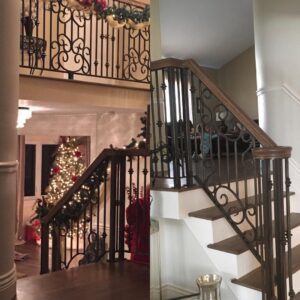
| Victorian or traditional | Scrolls, twists, and decorative collars |
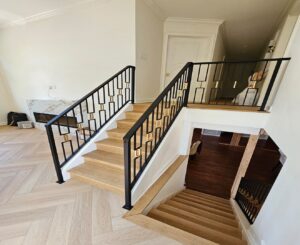
| Modern or contemporary | Clean flat bars, horizontal lines, minimal detail |
| Mediterranean or Spanish | Heavier scrollwork and hand-forged details |
Black is the classic color and hides wear well. Dark bronze or charcoal can soften the look against brick or stone. If you already have iron fences, gates, or window guards, match their style so everything reads as one design.
Custom or prefabricated?
Prefab railing kits are cheaper and quick to get, but outdoor stairs are rarely standard. Uneven steps, odd angles, and curved stoops make it hard for kits to fit well.
With a custom railing, the ironworker measures your stairs and builds the railing to fit them exactly. You get a tighter fit, a solid mount, and a design you actually chose. For front steps that everyone sees, custom is usually worth it.
When you compare quotes, ask each fabricator:
- Will you measure the stairs on site?
- What gauge and size of steel will you use for the posts and rails?
- How will the railing be finished to resist rust?
- Will it meet local code, and who handles any permits?
- What warranty comes with the work?
Installation and anchoring
A beautiful railing is useless if it wobbles. Most of a railing’s strength comes from how the installer anchors the posts.
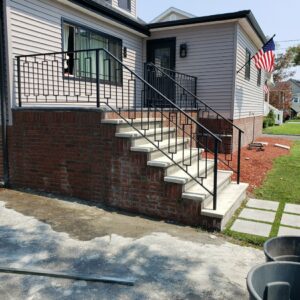
- Concrete or stone steps: Posts are usually core-drilled into the steps and set with hydraulic cement or epoxy, or bolted down with a base plate.
- Brick steps: Anchors should go into solid brick or the concrete behind it, not the mortar joints.
- Wood decks and porch stairs: Posts need to bolt into framing, not just the deck boards.
Water that sits around a post base is a common cause of rust and cracked concrete. Make sure the installer seals the base so water runs off. This is one job where hiring an experienced ironworker pays off.
What affects the cost
There’s no single price for wrought iron railings outdoors, because every set of stairs is different. These are the main things that move the number:
- Length: Priced by the linear foot, so longer runs cost more.
- Design detail: Scrolls, twists and hand-forged pieces add labor.
- Finish: Galvanizing and powder coating cost more up front but save on upkeep.
- Stair shape: Curves, landings and returns take more fabrication time.
- Installation: Core drilling, brick work or repairs to damaged steps add to the job.
The smart move is to get a written quote after an on-site measurement. A cheaper railing that rusts or loosens in a few years usually costs more in the end.
Keep it looking new
Iron doesn’t need much care, but a little attention each year goes a long way.
- Wash the railing with mild soap and water in spring and fall, especially near salt water.
- Look for chips, bubbles, or orange spots in the finish.
- Sand small rust spots, prime them, and touch up with matching exterior paint.
- Check that posts are tight and the base seals are intact.
- Use sand or a chloride-free de-icer near the posts in winter, and rinse any salt off in spring.
Get the right railing for your stairs
Choosing the best wrought iron railings for outdoor stairs comes down to four things: safety and code, a finish built for your climate, a style that fits your home, and a solid installation. Skip any one of them, and you’ll notice it sooner than you’d like.
If you’re in Freeport or anywhere on Long Island, PMF II Iron Works designs, builds, and installs custom wrought iron railings for outdoor stairs, porches, and entryways. They can measure your steps, help you choose a style, and build a railing designed to withstand the local weather.
Ready to upgrade your front steps? Visit pmfii.com to request a quote from PMF II Iron Works in Freeport, NY.