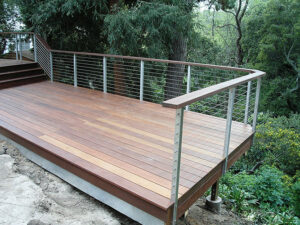
For most outdoor stainless cable railing, 316 is the better choice. It resists rust and corrosion far better, especially near salt water, pools, or roads treated with de-icing salt. But 304 can be a perfectly good, more affordable option for indoor railings and dry inland climates.
When I was planning cable railing for my deck, I assumed stainless steel was just stainless steel. Then a contractor asked me, “304 or 316?” and I had no idea what to say. It turns out that choice can decide whether your railing still looks brand new in ten years or starts showing brown rust spots after one winter.
Here’s what I learned about the difference and how to pick the right grade for your home.
What 304 and 316 Actually Mean
Both 304 and 316 are austenitic stainless steels, the most common family used for railings, hardware, and kitchen equipment. They look almost identical, and you can’t tell them apart by eye.
The difference is in the recipe:
- 304 stainless steel contains roughly 18% chromium and 8% nickel. That’s why you’ll sometimes hear it called “18/8” stainless. The chromium forms a thin protective layer on the surface that keeps rust away in normal conditions.
- 316 stainless steel has a similar base but adds about 2% to 3% molybdenum, plus a little more nickel. That molybdenum is the key. It makes the steel much more resistant to chlorides, the salts found in seawater, pool water, and road de-icers.
This is why 316 is often called “marine grade” stainless steel. It’s the standard choice for boats, docks, and coastal buildings.
304 vs 316 Stainless Cable Railing at a Glance
| Feature | 304 stainless | 316 stainless |
|---|---|---|
| Key ingredients | About 18% chromium, 8% nickel | Chromium, nickel, plus 2% to 3% molybdenum |
| Corrosion resistance | Good in dry, mild conditions | Excellent, especially against salt and chlorine |
| Best for | Indoor railings, dry inland decks | Outdoor decks, coastal homes, pools, snowy regions |
| Appearance | Bright, modern finish | Same look as 304 |
| Strength | Strong and durable | Very similar strength |
| Maintenance | More cleaning needed outdoors | Less upkeep over time |
| Cost | Lower upfront | Higher upfront |
| Long-term value | Can cost more if it stains or corrodes | Usually better value outdoors |
In short, they look and perform the same structurally. The real difference is how they hold up against moisture and salt over time.
When to Choose 316 (and When 304 Is Fine)
Choose 316 stainless cable railing if:
- You live near the ocean, a bay, or any salt water. Salt in the air travels farther inland than most people expect.
- Your railing is around a pool or hot tub, where chlorine and splashing water are constant.
- You live where roads and walkways are salted in winter, which is much of the Northeast and Midwest.
- The railing is fully outdoors and exposed to rain, snow, and humidity year-round.
- You want the lowest possible maintenance for decades.
304 can work well if:
- The railing is indoors, like a staircase, loft, or interior balcony.
- You live in a dry, inland climate far from salt and pools.
- The railing is covered or sheltered from the weather.
- You’re comfortable with occasional cleaning to keep it looking its best.
My rule of thumb: if you’re even unsure, go with 316. The extra upfront cost is usually small compared to replacing stained or corroded cables later.
One more tip: make sure the cables, fittings, and posts are all the same grade. Mixing grades, or mixing stainless with other metals, can lead to uneven corrosion right where parts meet.
Caring for Your Stainless Cable Railing
Even 316 isn’t completely maintenance-free. A little care keeps either grade looking great.
- Rinse regularly. Hose it down with fresh water every few weeks, more often near the coast or a pool, to wash away salt and dirt.
- Clean gently. Use mild soap and a soft cloth. Avoid steel wool or wire brushes, which leave behind particles that can rust.
- Treat light staining early. Small brown spots, often called “tea staining,” usually come off with a stainless steel cleaner.
- Check cable tension. Cables can loosen over time. Residential codes require that a 4-inch sphere can’t pass through a required guard (see the code section below), so keep them tight.
- Inspect fittings yearly. Look for loose hardware or corrosion where cables meet posts.
- Keep harsh chemicals away. Bleach and some masonry cleaners can damage the protective surface.
What Government Agencies and Building Codes Say
I didn’t want to rely only on manufacturer claims, so I looked at what government agencies and building codes say. Here’s what’s worth knowing.
Federal Highway Administration (FHWA). The FHWA, part of the U.S. Department of Transportation, has researched corrosion-resistant stainless steels, including 316 and 316L, for bridges exposed to deicing salts and coastal environments. Its testing used repeated wet-dry soaking in salt solution to mimic northern bridge decks in winter, plus exposure at a coastal marine site in Florida. Those are exactly the conditions an outdoor railing faces, and 316 is one of the grades engineers turn to for them.
New York State Department of State. New York’s Residential Code is built on the International Residential Code (IRC), which the state incorporates by reference, and the rules for guards are in Section R312. Under IRC Section R312.1.3, a required guard can’t have openings that let a 4-inch sphere pass through, and guards on the open side of stairs can’t let a 4 3/8-inch sphere through. Cables flex when pushed, so installers typically space them closer than 4 inches and keep them under firm tension. Code editions are updated from time to time, and New York City has its own building code, so always confirm with your local building department before you build.
Occupational Safety and Health Administration (OSHA). If your railing is for a business or workplace rather than a home, OSHA’s federal guardrail rules in 29 CFR 1910.29 also apply. These cover things like rail height, strength, and smooth surfaces. Home decks and stairs follow residential building codes instead.
Who I’d Call: PMF II Iron Works
Choosing the right grade is only half the job. The other half is having it fabricated and installed by people who know metal. If you’re in the New York area, especially Long Island, PMF II Iron Works is a name worth knowing.
They’re a full-service custom steel and iron fabrication company based in Freeport, NY, and they’ve been in business since 1960. Railings are one of their core services, both interior and exterior, along with gates and iron repairs.
Here’s why I’d reach out to them:
- More than 60 years of experience. Established in 1960, they’ve built a long track record of knowledgeable, friendly service at competitive rates.
- Custom work. Every railing is made to fit your space instead of being a one-size-fits-all kit.
- Free design consultations. You can talk through 304 vs 316, cable spacing, and post styles before committing.
- Financing available. Helpful if you’re upgrading a large deck or multiple staircases.
- Easy booking. You can book an appointment online or browse their project gallery for ideas.
If you’re on Long Island, where salt air and snowy winters are both part of life, I’d ask them about 316 stainless for any outdoor cable railing.
| Contact | Details |
|---|---|
| Address | 88 E. Merrick Rd, Freeport, NY 11520 |
| Phone | (516) 647-8300 |
| Website | pmfii.com |
Final Thoughts
So, which stainless cable railing grade is best? For outdoor railings, especially near salt water, pools, or winter road salt, 316 is worth the extra cost. For indoor or sheltered railings in dry climates, 304 can do the job at a lower price. Either way, matching grades across all parts and keeping up with simple care will help your railing last for decades.
If you’re in the New York area and ready to plan your project, call PMF II Iron Works at (516) 647-8300 to set up a free design consultation.
Sources:
- FHWA: Research on corrosion-resistant stainless steel reinforcement (FHWA-HRT-07-039)
- New York State Department of State: Residential Exit Doors, Stairways, Landings, Handrails, and Guards