The best custom deck railing meets your local building code first and looks great second. Once safety is covered, you can choose the material and style that suit your home, from classic wrought iron to sleek cable or glass.
I learned this when I finally replaced the wobbly wooden railing on my back deck. I’d been eyeing photos of elegant iron railings for years, but when I started planning, I realized I had no idea how high a railing needed to be, how far apart the balusters could go, or whether my old railing was even safe. It wasn’t.
Here’s what I found out about building codes, the best custom deck railing materials, and how to get a railing that’s both safe and beautiful.
Safety First: What the Codes and Regulators Say
A deck railing (the code calls it a “guard”) isn’t just decoration. It’s the only thing standing between your family and a fall. Before choosing a style, it helps to know what government agencies and building codes require.
New York State Department of State
New York’s Residential Code is based on the International Residential Code (IRC). The Department of State’s Code Outreach Program confirms that the guard requirements in Section R312 apply to decks raised 30 inches or more above the ground below, and that lumber used for guard rails must be approved for exterior use. The department also points homeowners and builders to a free “Deck Safety and the Codes” class from the International Code Council.
Local building departments. On Long Island, the Village of Malverne’s 2025 deck guidelines, based on the current Residential Code of New York State, say guards are required on decks more than 30 inches above grade and must be at least 36 inches high. Stair handrails must sit between 34 and 38 inches above the step nosing.
Opening limits. Under IRC Section R312.1.3, which New York follows, guards can’t have openings that let a 4-inch sphere pass through. On the open sides of stairs, the limit is 4 3/8 inches. This rule is what keeps small children from slipping through.
Strength. The IRC also requires guards to resist a 200-pound concentrated load at the top rail (Table R301.5). That’s why solid post connections and a good fabricator matter so much.
New York City. If you live in the five boroughs, the NYC Department of Buildings applies the New York City Building Code instead. Its code notes for decks and porches also require guards where a deck is more than 30 inches above adjacent grade.
U.S. Consumer Product Safety Commission (CPSC)
The CPSC has issued recalls for deck railing products that could fail, including aluminum railing posts recalled because of a fall hazard. It’s a reminder that even store-bought railing systems can fail, and that quality materials and installation matter.
OSHA (for commercial properties). If your deck is part of a business or workplace, OSHA’s federal guardrail rules in 29 CFR 1910.29 may also apply.
Codes are updated over time, and towns can add their own rules, so always check with your local building department and get a permit before you build.
The Best Custom Deck Railing Options
Once you know the safety rules, it’s time for the fun part. Here’s how the most popular custom deck railing materials compare.
| Railing type | Look | Safety and strength | Maintenance | Best for |
|---|---|---|---|---|
| Wrought iron or steel | Classic, elegant, fully customizable | Excellent; very strong when properly anchored | Repaint or touch up powder coat occasionally | Traditional homes, front porches, statement decks |
| Aluminum | Clean and modern | Good; lighter than steel | Very low; won’t rust | Coastal homes, low-maintenance decks |
| Stainless steel cable | Minimal, nearly invisible | Strong if cables stay tight to meet the 4-inch rule | Retension cables, rinse off salt | Decks with views |
| Glass panels | Sleek and open | Strong with tempered or laminated safety glass | Regular cleaning | Modern homes and waterfront views |
| Wood | Warm and natural | Good when built and fastened correctly | Stain or seal every few years | Rustic and budget-friendly decks |
| Composite or vinyl | Wood-look or clean white | Good with tested systems | Very low | Busy homeowners |
My Top Picks for Safety and Style
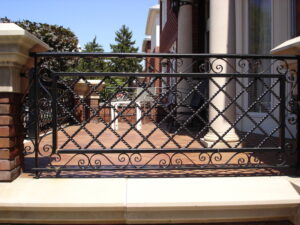
Custom wrought iron or steel railing is my favorite all-rounder. It’s incredibly strong, can be designed in almost any pattern, and lasts for decades with simple care. A custom fabricator can also match it to your gates, stair rails, and porch railings for a cohesive look.
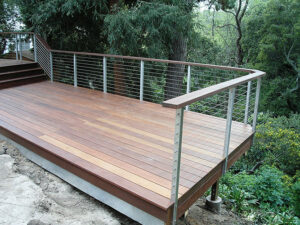
Cable railing is the top choice if you want an unobstructed view, as long as it’s installed by someone who understands cable spacing and tension.
Glass railing gives the most modern look, especially with a metal top rail and posts for added strength.
Mixed materials, like a steel frame with cable, glass, or decorative iron panels, often give you the best of both worlds.
Design Tips: Style Without Sacrificing Safety
- Match your home’s architecture. Scrollwork and finials suit traditional and Victorian homes, while straight pickets, cable, or glass suit modern ones.
- Keep spacing under 4 inches. Decorative patterns still have to pass the 4-inch sphere test, including the gaps at the bottom of the railing.
- Avoid climbable designs. Horizontal bars and wide decorative ledges can act like a ladder for children. Vertical pickets are safer for families.
- Choose a durable finish. Powder coating or galvanizing protects steel from rust, especially in snowy, salty Long Island winters.
- Plan the top rail. A wider top cap can double as a drink ledge, but make sure it’s sturdy and securely fastened.
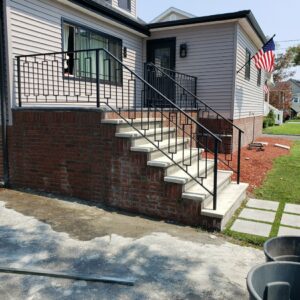
- Coordinate with stairs and gates. Matching stair rails, deck railing, and gates make the whole space look custom.
- Add lighting. Post cap lights or under-rail lighting improve safety at night and add instant curb appeal.
- Insist on solid connections. Posts must be securely fastened to the deck’s framing to meet the 200-pound load requirement. This is where custom fabrication and professional installation really pay off.
Who I’d Call on Long Island: PMF II Iron Works
A custom deck railing is only as safe as the people who build and install it. If you’re on Long Island or elsewhere in New York, PMF II Iron Works is a name worth knowing.
Based in Freeport, NY, and operating as Iron Works of LI Inc., PMF II is a full-service custom iron and steel fabrication company. Railings are one of their core services, both interior and exterior, along with gates and iron repairs. Their project photos include exterior railings, gates and fencing, staircases, and custom aluminum interior railings.
Here’s why they’d be on my shortlist:
- Experience since 1960. They’ve spent decades focused on customer satisfaction, with knowledgeable, friendly service at competitive rates.
- Truly custom work. Every railing is designed and fabricated for your space to meet code and match your home’s style.
- Free design consultations. A great chance to talk through materials, patterns, and code requirements before you commit.
- Financing available for larger projects.
- Easy booking. You can book an appointment online or browse their project gallery for ideas.
When you meet with them, bring your deck height and photos, and ask how they’ll handle the 36-inch height, 4-inch spacing, and post connections your town requires.
| Contact | Details |
|---|---|
| Address | 88 E. Merrick Rd, Freeport, NY 11520 |
| Phone | (516) 647-8300 |
| info@pmfii.com | |
| Website | pmfii.com |
Final Thoughts
The best custom deck railing meets code first, at least 36 inches high, no gaps over 4 inches, and strong enough to hold a 200-pound load, and then reflects your style, whether that’s classic wrought iron, cable, or glass. If you’re on Long Island, call PMF II Iron Works at (516) 647-8300 for a free design consultation.
Sources
- New York State Department of State: Code Outreach Program, Deck Update (2021-04)
- New York State Department of State: Residential Exit Doors, Stairways, Landings, Handrails, and Guards
- Village of Malverne, NY: 2025 Deck Code Guidelines
- NYC Department of Buildings: Code Notes, Decks and Porches
- eCFR: OSHA 29 CFR 1910.29, Fall Protection Systems Criteria and Practices