When I bought my older home on Long Island, the front steps had a wobbly wooden railing that looked tired and felt unsafe. I wanted something strong that would also suit the house’s classic charm. That’s when I started looking into iron.
Iron has been used for railings for centuries, and for good reason. It’s strong, it lasts for decades, and it can be shaped into almost any design. Below are the iron railing styles I found most beautiful and practical, with simple examples to help you picture each one on your own home.
Why Iron Never Goes Out of Style
Trends come and go, but iron railings still look right on everything from brick colonials to modern farmhouses. Here’s why so many homeowners choose iron:
- Strength: It holds up to heavy use, leaning, and bumps.
- Long life: With basic care, an iron railing can last for generations.
- Design freedom: It can be bent, twisted, and shaped into custom patterns.
- Curb appeal: It adds instant character to steps, porches, and balconies.
Top Iron Railing Styles to Consider
1. Classic Straight Picket
This is the simplest and most popular of all iron railing styles. It uses straight vertical bars (pickets) spaced evenly between a top and bottom rail.
Best for: Front steps, porches, and homes with a clean, traditional look.
Example: A white Cape Cod house with black straight-picket railings on the front steps looks neat, crisp, and timeless.
2. Scroll Design
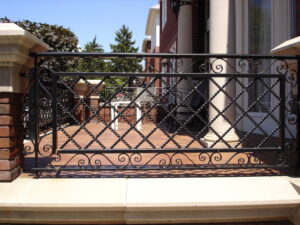
Scrollwork adds curls and swirls between the pickets or along the top. It gives a railing an elegant, old-world feel.
Best for: Victorian, Colonial, and Mediterranean-style homes.
Example: A brick colonial with scroll accents on its balcony railing instantly looks more graceful and grand.
3. Twisted Pickets
Each picket is twisted along its length, which catches the light and adds texture without being too busy.
Best for: Homeowners who want a little detail but not a lot of ornament.
4. Basket Pickets
Basket pickets have a rounded “cage” shape in the middle of each bar. They add a handcrafted touch that stands out up close.
Best for: Entryways and staircases where guests will see the railing at eye level.
5. Spear-Top or Finial Railings
These railings have decorative tips, such as spears, balls, or fleur-de-lis, on top of each picket or post.
Best for: Garden borders, front yard railings, and balconies where the top of the railing is on display.
Example: A short iron railing with spear tops along a front walkway gives the whole yard a classic, estate-like look.
6. Panel and Pattern Designs
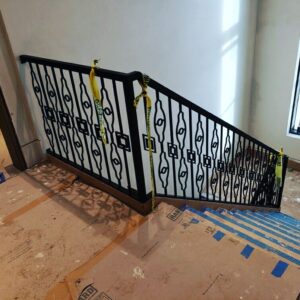
Instead of single pickets, these railings use repeating patterns such as circles, diamonds, or geometric shapes inside each panel.
Best for: Homes that mix traditional and modern styles.
7. Custom Railings
The most personal option is a fully custom design. You can add a family initial, match the pattern of your front gate, or copy a design from an older part of your home.
Example: A homeowner in Freeport matches a new porch railing to the scroll pattern on an existing iron gate, so the whole front of the house looks like one design.
Quick Style Comparison
| Style | Look | Best for |
|---|---|---|
| Straight picket | Clean and simple | Front steps, porches |
| Scroll | Elegant, old-world | Colonial, Victorian homes |
| Twisted picket | Subtle texture | Light detail |
| Basket picket | Handcrafted | Entryways, stairs |
| Spear or finial top | Stately | Gardens, balconies |
| Panel pattern | Traditional to modern | Mixed-style homes |
| Custom | One of a kind | Matching gates and existing ironwork |
How to Pick the Right Style for Your Home
- Match your home’s architecture. Simple pickets suit clean, traditional homes. Scrolls and finials suit grand or historic homes.
- Think about where the railing goes. Steps and staircases need a sturdy handrail. Balconies and porches are where decorative styles shine.
- Follow safety rules. In New York, guards on porches and landings must be at least 36 inches high, with openings small enough that a 4-inch sphere can’t pass through. Stair guards have their own rules. See the NY Department of State’s guide to handrails and guards.
- Plan for upkeep. Iron needs a good protective coat to fight rust, especially near salty Long Island air. Ask about the finish before you buy.
- Work with a local fabricator. A custom-built railing fits your steps exactly and lasts much longer than a store-bought kit.
Quick FAQs
Which iron railing style is the most timeless?
The classic straight picket. It suits almost any home and never looks dated.
Can iron railings be custom-made?
Yes. A skilled ironworker can shape iron into scrolls, twists, patterns, or a design you sketch yourself.
Do iron railings rust?
Iron can rust if it isn’t protected. A quality finish and a quick touch-up when you spot chips will keep it looking good for years.
Final Thoughts
The right railing styles can turn a plain entrance into the most charming part of your home, and iron gives you strength and beauty that lasts for decades. If you’re on Long Island and want a custom iron railing, PMF II Iron Works has been crafting ironwork since 1960 and offers free design consultations. Visit them at 88 E. Merrick Rd, Freeport, NY 11520, call (516) 647-8300, or contact them online today.