If you’ve ever stood at the top of a staircase and gripped the railing for support, you already understand why railing height matters. It’s not just a building code checkbox. It can be the difference between catching yourself and taking a bad fall. Whether you’re building a new home, renovating an old one, or trying to pass an inspection, every homeowner should know how high a railing should be for stairs.
In this guide, PMF II breaks it all down for you: the standard measurements, what the codes actually require, common mistakes, and tips for getting it right the first time.
Why railing height matters
Stair railings exist for one main reason: safety. A railing that’s too low won’t support you when you lose your footing. One that’s too high makes you reach awkwardly and throws off your balance. The 34-to-38-inch range in today’s codes is the window in which most adults can comfortably grip a rail and catch themselves if they slip.
Correct railing height is also a legal requirement. If your railing doesn’t meet your local building code, you could face a failed inspection, a delayed sale, or liability if someone gets hurt on your stairs.
The standard answer: how high should a railing be?
For most staircases in the United States, a handrail must be 34 to 38 inches high. You measure it straight up from the line that connects the stair nosings (the front edges of the steps) to the top of the rail. [2][3]
Here’s a quick reference:
| Setting | Handrail height | Guard height |
|---|---|---|
| Residential (IRC) | 34–38 in | 36 in min. at landings, decks and balconies; 34 in min. on the open side of stairs |
| Commercial (IBC) | 34–38 in | 42 in min. (some dwelling-unit exceptions allow less) |
| Workplaces (OSHA) | 30–38 in | Guardrails 42 in ± 3 in; stair rail systems installed since Jan 17, 2017, 42 in min. [1] |
These are the national model codes. New York’s current residential code is based on the 2024 IRC, with state changes [4], and your town may add its own rules. Always check with your local building department before you start.
Handrail vs. guardrail: know the difference
People often use these terms interchangeably, but they’re two different things with different rules.
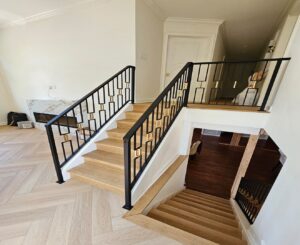
Handrail: The rail you hold as you walk up and down the stairs. It follows the slope of the stairs and must be 34 to 38 inches high, measured from the nosing line.
Guard (guardrail): A barrier along an open edge that stops people from falling off. Under the IRC, a guard is required where a floor, landing, deck, or stair is more than 30 inches above the floor or ground below. [2] In homes, guards must be at least 36 inches high, or 34 inches on the open side of stairs. In commercial buildings, the minimum is usually 42 inches.
If your stairs are open on one or both sides and high enough to need a guard, you may need both. On residential stairs, the top of a guard can also serve as the handrail if it sits between 34 and 38 inches and meets the grip-size rules.
How to measure railing height correctly
Measuring is simpler than it sounds:
- Find the stair nosing, the front edge of a stair tread.
- Hold a tape measure vertically at the nosing, straight up, not along the slope of the stairs.
- Measure to the top of the handrail, not its bottom or center.
- On a home staircase, the result should fall between 34 and 38 inches.
Repeat the measurement at several steps, especially on long runs. A rail that drifts outside the range at any point can still fail inspection.
Residential code: what the IRC says
The International Residential Code (IRC) is the model code for one- and two-family homes in most of the U.S. Its main stair railing rules are [2]:
- When required: A handrail is needed on at least one side of any flight with four or more risers. Stairs with three or fewer risers don’t require one, though it’s still a good idea.
- Height: 34 to 38 inches, measured vertically from the line connecting the stair nosings.
- Continuity: The handrail must run the full length of the flight, from above the top riser to above the bottom riser. A newel post at a turn, or a volute or starting easing over the lowest tread, is allowed.
- Ends: Handrail ends must return to the wall or end at a newel post or safety terminal, so sleeves and bags don’t catch.
- Wall clearance: Leave at least 1½ inches between the handrail and the wall.
- Grip size: A round rail must be 1¼ to 2 inches in diameter. Other shapes need a perimeter of 4 to 6¼ inches and a cross-section no wider than 2¼ inches, or a larger profile with finger recesses.
- Guard openings: Guard openings must stop a 4-inch sphere, or a 4⅜-inch sphere on the open sides of stairs. The triangle under the bottom rail on stairs must stop a 6-inch sphere.
New York’s residential code adopts these rules with state changes, so confirm the details with your local building department.
Commercial code: what the IBC says
Commercial buildings, offices, apartment buildings, and public spaces must comply with the International Building Code (IBC). Handrail height is the same, 34 to 38 inches, but other rules are stricter [3]:
- Handrails on both sides: Stairways generally need handrails on both sides. Stairs inside a single dwelling unit are an exception.
- Guard height: At least 42 inches, with some exceptions inside dwelling units.
- Guard openings: Openings must stop a 4-inch sphere at a height of up to 36 inches. Between 36 and 42 inches, the limit is a 4⅜-inch sphere. The triangle at the bottom of a stair guard must stop a 6-inch sphere.
- Extensions: Handrails generally extend at least 12 inches past the top of the stairs and one tread depth past the bottom.
If you’re working on a rental building, a mixed-use property, or a multi-family building, ask your building department whether the IRC or the IBC applies.
Common mistakes homeowners make
Even experienced DIYers get these wrong. Here are the errors PMF II sees most often:
- Measuring along the slope instead of straight up. The measurement must be vertical from the nosing, not along the angle of the stairs.
- Measuring from the back of the tread. Measure from the nosing line, the front edge of each step. Measuring from farther back gives you the wrong number.
- Breaking the rail partway down the flight. The handrail must be continuous for the full flight, not just at the top and bottom.
- Ignoring local amendments. National codes are a starting point. Your state or town may have stricter rules.
- Choosing a rail that’s hard to grip. A rail at the right height can still fail if it’s too thick or oddly shaped. Round rails must be 1¼ to 2 inches in diameter. Other shapes need a perimeter of 4 to 6¼ inches and a cross-section of no more than 2¼ inches.
- Balusters spaced too far apart. On the open side of stairs, a 4⅜-inch sphere must not pass through. That’s there to keep small children from slipping through.
Railing height for outdoor stairs
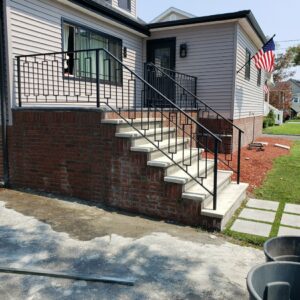
Outdoor stair railings follow the same height rules as indoor ones: 34 to 38 inches for handrails. A few extra things matter outside:
- Material: Choose materials built to withstand the weather, such as galvanized or powder-coated steel, wrought iron, aluminum, composite, or pressure-treated wood.
- Strength: Handrails and guards must resist a 200-pound load applied in any direction at the top, so posts need to be solidly anchored.
- Decks: Under the IRC, deck guards must be at least 36 inches high wherever the deck is more than 30 inches above the ground. Some towns require 42 inches, so check locally.
If your outdoor stairs lead from a deck or porch more than 30 inches above the ground, you’ll need guards on that deck or porch as well.
A quick summary
- Handrail height (homes and commercial): 34 to 38 inches, measured vertically from the stair nosings
- Residential guard height: 36 inches min.; 34 inches min. on the open side of stairs
- Commercial guard height: 42 inches min.
- When a handrail is required (homes): Any flight with four or more risers
- Guards required: Where the drop is more than 30 inches
- Grip size: 1¼ to 2 inches for round rails
- Always verify: Your state or local code may be stricter
Get your stair railing right before it costs you more
Getting stair railing height right isn’t complicated, but it takes attention to detail. The 34- to 38-inch range works because it lets most adults grip the rail, maintain their balance, and catch themselves if they stumble.
Whether you’re doing a full renovation or replacing an old rail, measuring carefully and checking your local code can save you from a failed inspection, or worse, an accident.
At PMF II Iron Works, we believe the best home improvements are done safely and done right. When in doubt, talk to a licensed contractor or your local building department before you start drilling. If you’re planning new stair railings, visit pmfii.com to request a quote.
Sources
- OSHA 1910.29, fall protection systems
- Spokane County, residential handrails and guards (2021 IRC summary)
- Data Driven AEC, IBC 2024 guard and handrail requirements
- NY Department of State, 2025 Uniform Code changes